
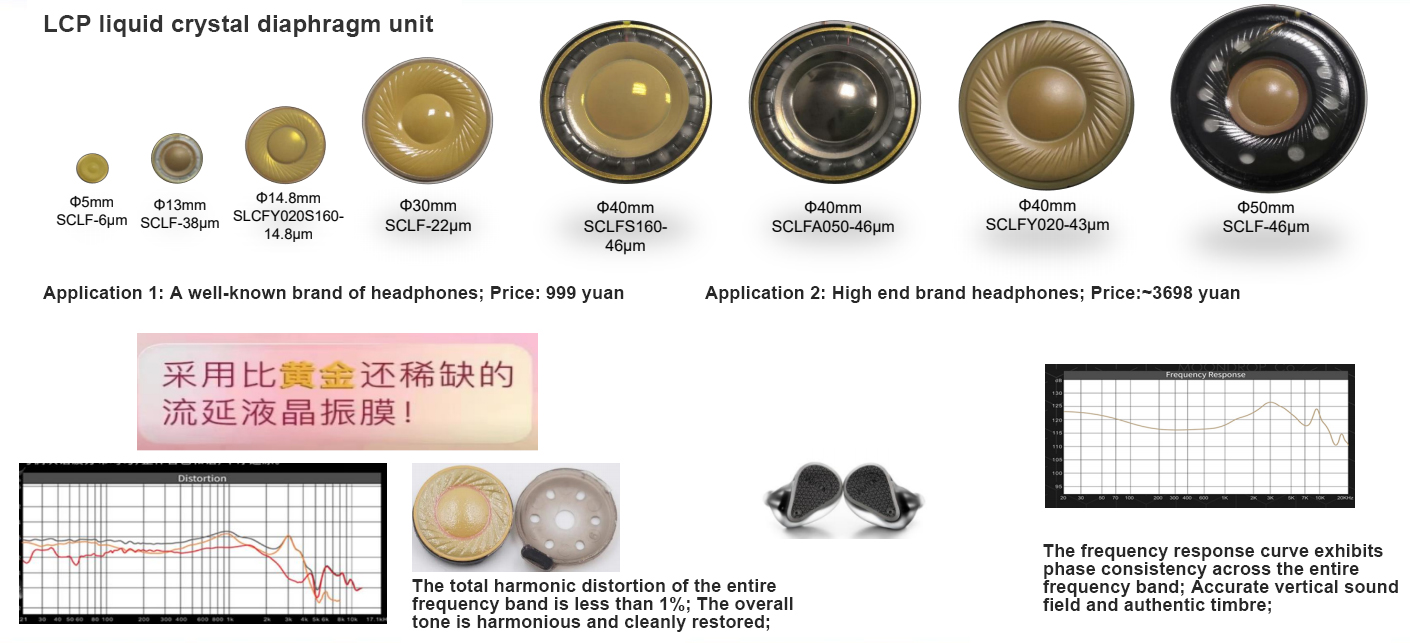
There are many types of diaphragms, including paper diaphragms, wooden diaphragms, plastic diaphragms, metal diaphragms, biological diaphragms, etc. Generally, in headphones, the design requirements for diaphragms are that the lighter the weight and the better the rigidity. As a thin film material for the driving unit, diaphragms need to have seemingly contradictory characteristics such as light weight, high rigidity, and high internal loss. According to the working principle of dynamic headphones, a good diaphragm should exhibit good elasticity and inertia in dynamic performance. The diaphragm has sufficient stiffness and exhibits linear elasticity during vibration, with good dynamic performance and strong ability to reproduce sound signals. On the other hand, the diaphragm is lightweight and has low inertia, resulting in excellent performance in the details of sound. For most of the dynamic earphones currently on the market, plastic diaphragms are commonly used, even those priced at thousands of yuan. The plastic diaphragm referred to here is actually a general term for various polymer compounds (including PET/PEN/PEI/PI/LCP/PEEK/PC/PPS/PAR, etc.), and the physical properties of each compound vary. Their commonalities are extremely high plasticity, easy processing, low cost, but poor rigidity. To achieve better rigidity, it is necessary to increase the thickness of the diaphragm at the cost. Due to their low internal resistance and poor rigidity, this type of diaphragm is prone to significant distortion, making it difficult to accurately reproduce the original sound. However, due to cost advantages, most headphones on the market use plastic diaphragms.
13750037362 (Mr. Huang)


 English
 中文站
中文站